<?xml version="1.0" encoding="utf-8"?><feed xmlns="http://www.w3.org/2005/Atom" ><generator uri="https://jekyllrb.com/" version="3.10.0">Jekyll</generator><link href="http://roboticslaburjc.github.io/feed.xml" rel="self" type="application/atom+xml" /><link href="http://roboticslaburjc.github.io/" rel="alternate" type="text/html" /><updated>2026-04-08T09:51:31+00:00</updated><id>http://roboticslaburjc.github.io/feed.xml</id><title type="html">RoboticsLabURJC</title><subtitle>Programming Robot Intelligence</subtitle><entry><title type="html">BT Studio: un IDE web para la programación de aplicaciones robóticas con Behavior Trees</title><link href="http://roboticslaburjc.github.io/tfg/TFG-Oscar-Martinez/" rel="alternate" type="text/html" title="BT Studio: un IDE web para la programación de aplicaciones robóticas con Behavior Trees" /><published>2024-03-14T00:00:00+00:00</published><updated>2024-03-14T00:00:00+00:00</updated><id>http://roboticslaburjc.github.io/tfg/TFG-Oscar-Martinez</id><content type="html" xml:base="http://roboticslaburjc.github.io/tfg/TFG-Oscar-Martinez/"><![CDATA[<p>Óscar has successfully presented his final bachelor’s project named <strong>“BT Studio: un IDE web para la programación de aplicaciones robóticas con Behavior Trees”</strong>.</p>

<table>
  <thead>
    <tr>
      <th style="text-align: left">Information and Resources</th>
      <th> </th>
    </tr>
  </thead>
  <tbody>
    <tr>
      <td style="text-align: left">Work</td>
      <td><a href="https://github.com/RoboticsLabURJC/2023-tfg-oscar-martinez/blob/main/tfg_final.pdf">PDF</a></td>
    </tr>
    <tr>
      <td style="text-align: left">Slides</td>
      <td><a href="https://github.com/RoboticsLabURJC/2023-tfg-oscar-martinez/blob/main/slides.pdf">PDF</a></td>
    </tr>
    <tr>
      <td style="text-align: left">Git Repository</td>
      <td><a href="https://github.com/JdeRobot/bt-studio">Link</a></td>
    </tr>
    <tr>
      <td style="text-align: left">Tutor</td>
      <td>JoseMaria Cañas Plaza</td>
    </tr>
  </tbody>
</table>

<div style="text-align: justify"> 

In this project, the first release of BT Studio has been developed. BT Studio is an open-source tool crafted for the development of robotic applications. Its primary objective is to facilitate the quick deployment of behavior tree-based robotic applications within ROS 2. In BT Studio, a robotic app is defined as an graphical tree coupled with actions scripted in Python, which the tool then translates into a ROS 2 package. This process circumvents the unnecessary complexities often associated with ROS-specific configurations, offering developers a more streamlined approach. The generated robotics application may be run locally or even from the browser inside a docker container with one button click.


</div>

<p><br />
<br /></p>

<p><strong>Video:</strong>
<br /></p>

<p><a href="https://www.youtube.com/watch?v=a4c-nRevF_c"><img src="https://img.youtube.com/vi/a4c-nRevF_c/0.jpg" alt="IMAGE ALT TEXT HERE" /></a></p>]]></content><author><name></name></author><category term="TFG" /><category term="tfg" /><category term="BehaviorTrees" /><category term="robotics tools" /><category term="tutor:jmplaza" /><summary type="html"><![CDATA[Óscar has successfully presented his final bachelor’s project named “BT Studio: un IDE web para la programación de aplicaciones robóticas con Behavior Trees”.]]></summary></entry><entry><title type="html">TFG: Autonomous driving for racing cars based on RL and using AWS Deep Racer and Gazebo</title><link href="http://roboticslaburjc.github.io/tfg/TFG-LuisMiguel-Lopez/" rel="alternate" type="text/html" title="TFG: Autonomous driving for racing cars based on RL and using AWS Deep Racer and Gazebo" /><published>2023-12-01T00:00:00+00:00</published><updated>2023-12-01T00:00:00+00:00</updated><id>http://roboticslaburjc.github.io/tfg/TFG-LuisMiguel-Lopez</id><content type="html" xml:base="http://roboticslaburjc.github.io/tfg/TFG-LuisMiguel-Lopez/"><![CDATA[<p>Luis Miguel López  has successfully presented his final degree project named <strong>“Conducción Autónoma de coches de carreras basado en Reinforcement Learning con AWS DeepRacer y Gazebo”</strong>.</p>

<table>
  <thead>
    <tr>
      <th style="text-align: left">Information and Resources</th>
      <th> </th>
    </tr>
  </thead>
  <tbody>
    <tr>
      <td style="text-align: left">Work</td>
      <td><a href="https://burjcdigital.urjc.es/bitstream/handle/10115/25616/2023-24-EIF-O-2327-2327037-lm.lopez.2019-MEMORIA.pdf">PDF</a></td>
    </tr>
    <tr>
      <td style="text-align: left">Slides</td>
      <td><a href="https://github.com/RoboticsLabURJC/2022-tfg-luismiguel-lopez/tree/master/slides">PDF</a></td>
    </tr>
    <tr>
      <td style="text-align: left">Git Repository</td>
      <td><a href="https://github.com/RoboticsLabURJC/2022-tfg-luismiguel-lopez">Link</a></td>
    </tr>
    <tr>
      <td style="text-align: left">Tutor</td>
      <td>Roberto Calvo Palomino</td>
    </tr>
  </tbody>
</table>

<div style="text-align: justify"> 


<br />
The automotive world does not escape the advances of robotics and AI. one of the great dreams in the history of humanity
Since cars circulate in our world, autonomous cars are becoming increasingly popular every day
closer to being a reality. In some countries, autonomous cars are already going circulate through large cities, even doing taxi services.


The world of autonomous driving is also related to the racing motorsport, with the existence of some competitions in which one
one of the most important elements, if not the most, of a racing car, which is the
pilot is not a person but a computer capable of understanding and analyzing the
car environment to drive himself as fast as possible around track.

<br />
<br />

This TFG focuses on the development of autonomous driving behaviors
based on reinforcement learning in racing circuits, in order to obtain
reactive and appropriate behaviors in different scenarios using
a robot with the necessary characteristics to carry out these behaviors,
the AWS Deepracer.

<br />
The AWS Deepracer league is a competition where participants try to build an autonomous behavior
 in a small racing car using artificial intelligence. In this
competition, participants are provided with a small robot with
autonomous capabilities, the AWS Deepracer promoted by Amazon, together with a simulated environment
in which the participants must program the robot with one goal: be the fastast one!


<br />
<br />

<img src="https://github.com/RoboticsLabURJC/2022-tfg-luismiguel-lopez/assets/78983070/942187d8-f25b-47bc-8f50-cc8c6a709cef" style="max-width: 800px;  display: block; margin-left: auto; margin-right: auto; width: 90%;" />


<br />
<br />


Check the video below to see more details about the system:

</div>
<p><br />
<br /></p>

<iframe width="560" height="315" src="https://www.youtube.com/embed/g7wZ5BbI_jo?si=EDjrmFvWqP7NNVtG" title="YouTube video player" frameborder="0" allow="accelerometer; autoplay; clipboard-write; encrypted-media; gyroscope; picture-in-picture; web-share" allowfullscreen=""></iframe>]]></content><author><name></name></author><category term="TFG" /><category term="tfg" /><category term="RL" /><category term="autonomous-driving" /><category term="racing" /><category term="tutor:rocapal" /><summary type="html"><![CDATA[Luis Miguel López has successfully presented his final degree project named “Conducción Autónoma de coches de carreras basado en Reinforcement Learning con AWS DeepRacer y Gazebo”.]]></summary></entry><entry><title type="html">TFG: Deep learning based framework to detect and analyze student behaviours in a classroom</title><link href="http://roboticslaburjc.github.io/tfg/TFG-Carlota-Vera/" rel="alternate" type="text/html" title="TFG: Deep learning based framework to detect and analyze student behaviours in a classroom" /><published>2023-11-17T00:00:00+00:00</published><updated>2023-11-17T00:00:00+00:00</updated><id>http://roboticslaburjc.github.io/tfg/TFG-Carlota-Vera</id><content type="html" xml:base="http://roboticslaburjc.github.io/tfg/TFG-Carlota-Vera/"><![CDATA[<p>Carlota Vera has successfully presented his final degree project named <strong>“Sistema de detección y análisis de emociones y comportamientos de estudiantes en un aula docente basado en Deep learning”</strong>.</p>

<table>
  <thead>
    <tr>
      <th style="text-align: left">Information and Resources</th>
      <th> </th>
    </tr>
  </thead>
  <tbody>
    <tr>
      <td style="text-align: left">Work</td>
      <td><a href="https://burjcdigital.urjc.es/bitstream/handle/10115/25235/2023-24-EIF-O-2327-2327037-c.verap.2019-MEMORIA_v2.pdf">PDF</a></td>
    </tr>
    <tr>
      <td style="text-align: left">Tutor</td>
      <td>Roberto Calvo Palomino</td>
    </tr>
  </tbody>
</table>

<div style="text-align: justify"> 


Artificial intelligence is already helping in the education field to understand the needs of each student and improve the learning methodologies for a better education.
Neural networks such as PoseNet or FaceMesh can help to understand the dynamic of the class without expose the student's privacy. In collaboration with <b><a href="https://tknika.eus/">Tknika</a></b> a deep learning vision-based framework has been developed to detect and analyze emotions, behaviours, movements and talk-action of the students in a regular class.
<br />
<br />
<iframe width="560" height="315" src="https://www.youtube.com/embed/M3dX9w7FFEE?si=SwFS-Lp45vTFIM-6" title="YouTube video player" frameborder="0" allow="accelerometer; autoplay; clipboard-write; encrypted-media; gyroscope; picture-in-picture; web-share" allowfullscreen=""></iframe>
<br />
<br />
This work focuses on developing a system for detecting and analyzing emotions
and behaviors based on AI on a teaching environment. Main goal of the project is to
provide useful information to teachers about student performance. This system
detection is based on algorithms that have been designed to perform a visual analysis of images and videos using pose and face neural networks for emotion detection. After all the analysis the information obtained is adapted to use as a guide and help for teachers, who will be able to understand visually the different events that occurred during a class in relation to a certain students.

Privacy has been treated as a central pillar in this project, that's why no images are saved, neither audio of the environment is analyzed.


</div>
<p><br />
<br /></p>]]></content><author><name></name></author><category term="TFG" /><category term="tfg" /><category term="DL" /><category term="classroom" /><category term="tutor:rocapal" /><summary type="html"><![CDATA[Carlota Vera has successfully presented his final degree project named “Sistema de detección y análisis de emociones y comportamientos de estudiantes en un aula docente basado en Deep learning”.]]></summary></entry><entry><title type="html">TFG: Autonomous drone navigation based on Reinforcement Learning for localizing a RF station</title><link href="http://roboticslaburjc.github.io/tfg/TFG-Cristian-Sanchez/" rel="alternate" type="text/html" title="TFG: Autonomous drone navigation based on Reinforcement Learning for localizing a RF station" /><published>2023-11-09T00:00:00+00:00</published><updated>2023-11-09T00:00:00+00:00</updated><id>http://roboticslaburjc.github.io/tfg/TFG-Cristian-Sanchez</id><content type="html" xml:base="http://roboticslaburjc.github.io/tfg/TFG-Cristian-Sanchez/"><![CDATA[<p>Cristian Sanchez has successfully presented his final degree project named <strong>“Navegación autónoma de un dron para localizar un transmisor de radio frecuencia basado en aprendizaje por refuerzo”</strong>.</p>

<table>
  <thead>
    <tr>
      <th style="text-align: left">Information and Resources</th>
      <th> </th>
    </tr>
  </thead>
  <tbody>
    <tr>
      <td style="text-align: left">Work</td>
      <td><a href="https://burjcdigital.urjc.es/bitstream/handle/10115/25289/2023-24-EIF-O-2327-2327037-c.sanchezro.2018-MEMORIA.pdf">PDF</a></td>
    </tr>
    <tr>
      <td style="text-align: left">Slides</td>
      <td><a href="https://github.com/RoboticsLabURJC/2022-tfg-cristian-sanchez/tree/main/slides">PDF</a></td>
    </tr>
    <tr>
      <td style="text-align: left">Git Repository</td>
      <td><a href="https://github.com/RoboticsLabURJC/2022-tfg-cristian-sanchez">Link</a></td>
    </tr>
    <tr>
      <td style="text-align: left">Tutor</td>
      <td>Roberto Calvo Palomino</td>
    </tr>
  </tbody>
</table>

<div style="text-align: justify"> 


Autonomous done navigation is getting attention in different fields during last years. Applications focused on people-rescue, surveillance, infrastructure inspection are being demanded nowadays, but drone must be operated autonomously by itself.

<br />
The focus of the study is on Unmanned Air Vehicles (UAV), whose use covers
from rescues in inaccessible areas, to inspections in the industry, or
inventoried, among many other examples.In parallel, we have the study of the Radio Frequency (RF) spectrum, which
covers a large part of the modern world, such as the use of communications
mobile phones, or in broadcasting using frequency bands such as FM radio. Thus,
Understanding and working on signal propagation can introduce us to new
useful applications for the world.


<br />
<br />

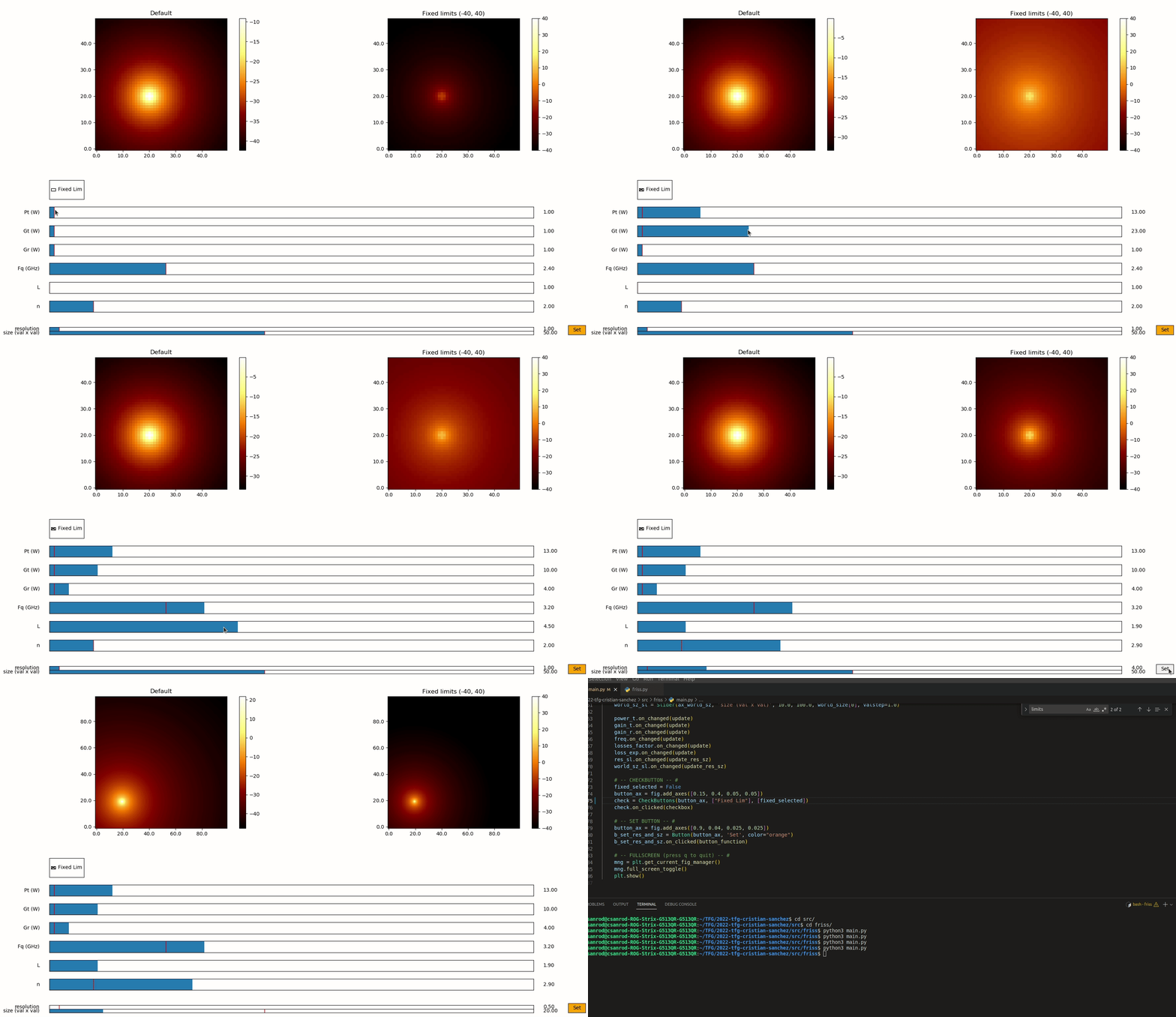
To evaluate properly this project, a FRISS model has been implemented in python and create a ROS node to export this feature to the ROS ecosystem. Check the PDF above for more information.

<img src="https://roboticslaburjc.github.io/2022-tfg-cristian-sanchez/images/friss_app.gif" style="max-width: 800px;  display: block; margin-left: auto; margin-right: auto; width: 90%;" />


<br />
<br />

The objective of this work is to developed a solution based on reinfocemente learning (Q-learning) that is able to learn how to reach a RF transmmiter at outdoor/indoor environment. Static and dynamic environments have been evaluated with obstácules in a realistic way.


<br />
<br />


Check the video below to see more details about the system:

</div>
<p><br />
<br /></p>

<iframe width="560" height="315" src="https://www.youtube.com/embed/oulD6hGlg3c?si=-SnPDANqRcVp-UHk" title="YouTube video player" frameborder="0" allow="accelerometer; autoplay; clipboard-write; encrypted-media; gyroscope; picture-in-picture; web-share" allowfullscreen=""></iframe>]]></content><author><name></name></author><category term="TFG" /><category term="tfg" /><category term="RL" /><category term="drones" /><category term="tutor:rocapal" /><summary type="html"><![CDATA[Cristian Sanchez has successfully presented his final degree project named “Navegación autónoma de un dron para localizar un transmisor de radio frecuencia basado en aprendizaje por refuerzo”.]]></summary></entry><entry><title type="html">TFM: Autonomous driving in traffic using end-to-end deep learning</title><link href="http://roboticslaburjc.github.io/tfm/TFG-Enrique-Shinohara/" rel="alternate" type="text/html" title="TFM: Autonomous driving in traffic using end-to-end deep learning" /><published>2023-09-21T00:00:00+00:00</published><updated>2023-09-21T00:00:00+00:00</updated><id>http://roboticslaburjc.github.io/tfm/TFG-Enrique-Shinohara</id><content type="html" xml:base="http://roboticslaburjc.github.io/tfm/TFG-Enrique-Shinohara/"><![CDATA[<p>Enrique Shinohara  has successfully presented her final master’s project named <strong>“Conducción autónoma en tráfico usando aprendizaje profundo extremo a extremo”</strong>.</p>

<table>
  <thead>
    <tr>
      <th style="text-align: left">Information and Resources</th>
      <th> </th>
    </tr>
  </thead>
  <tbody>
    <tr>
      <td style="text-align: left">Work</td>
      <td><a href="https://github.com/RoboticsLabURJC/2022-tfm-enrique-shinohara/blob/main/final/TFM_final.pdf">PDF</a></td>
    </tr>
    <tr>
      <td style="text-align: left">Slides</td>
      <td><a href="https://github.com/RoboticsLabURJC/2022-tfm-enrique-shinohara/blob/main/final/TFM_presentacion_FINAL_v5.0.pptx">PDF</a></td>
    </tr>
    <tr>
      <td style="text-align: left">Git Repository</td>
      <td><a href="https://github.com/RoboticsLabURJC/2022-tfm-enrique-shinohara">Link</a></td>
    </tr>
    <tr>
      <td style="text-align: left">Tutor</td>
      <td>JoseMaria Cañas Plaza and Sergio Paniego</td>
    </tr>
  </tbody>
</table>

<div style="text-align: justify"> 


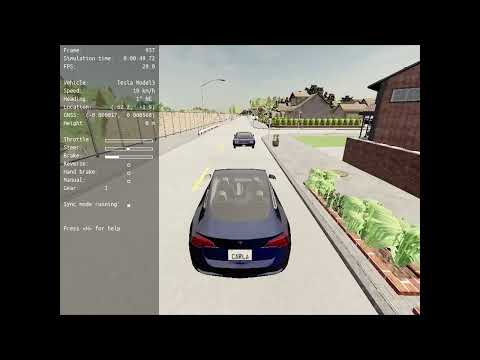
In this project an end-to-end vision-based deep learning approach for an autonomous car
to drive in traffic is presented. In this context the car should both keep the lane and also
keep a safety distance with the front vehicle, if any. The imitation learning approach has
been followed, creating a supervised dataset with the autopilot of CARLA simulator in
different traffic conditions which include front vehicles. A variant of the PilotNet model
has been developed, with additional dropout and the previous speed as input, and it has
been (re)trained with such in-traffic dataset. The experimental results show that the model
successfully drives the car in traffic conditions without losing performance in free road
conditions. It also keeps safety distance with the front cars and even properly generalizes
to several types of front vehicles.

<br />
<br />

A plugin for measuring the distance to the front vehicle has been created and added to
Behavior Metrics, an open-source autonomous driving assessment tool.

</div>
<p><br />
<br /></p>

<p><strong>Video:</strong>
<br /></p>

<p><a href="https://www.youtube.com/watch?v=mVSfxQeWwrQ"><img src="https://img.youtube.com/vi/mVSfxQeWwrQ/0.jpg" alt="IMAGE ALT TEXT HERE" /></a></p>]]></content><author><name></name></author><category term="TFM" /><category term="tfm" /><category term="IA" /><category term="autonomous driving" /><category term="tutor:sergiopaniego" /><category term="tutor:jmplaza" /><summary type="html"><![CDATA[Enrique Shinohara has successfully presented her final master’s project named “Conducción autónoma en tráfico usando aprendizaje profundo extremo a extremo”.]]></summary></entry><entry><title type="html">TFG: Assistance exoskeletons in rehabilitation and pose IA models</title><link href="http://roboticslaburjc.github.io/tfg/TFG-Veronica-Tornero/" rel="alternate" type="text/html" title="TFG: Assistance exoskeletons in rehabilitation and pose IA models" /><published>2023-07-13T00:00:00+00:00</published><updated>2023-07-13T00:00:00+00:00</updated><id>http://roboticslaburjc.github.io/tfg/TFG-Veronica-Tornero</id><content type="html" xml:base="http://roboticslaburjc.github.io/tfg/TFG-Veronica-Tornero/"><![CDATA[<p>Verónica Tornero has successfully presented her final degree project named <strong>“Sistema de control para la rehabilitación motora con
un exoesqueleto y evaluación de redes posnet como ayuda a terapias”</strong>.</p>

<table>
  <thead>
    <tr>
      <th style="text-align: left">Information and Resources</th>
      <th> </th>
    </tr>
  </thead>
  <tbody>
    <tr>
      <td style="text-align: left">Work</td>
      <td><a href="https://github.com/RoboticsLabURJC/2022-tfg-veronica-tornero/blob/main/final/2022-23-EIF-A-2327-2327037-v.tornero.2018-MEMORIA.pdf">PDF</a></td>
    </tr>
    <tr>
      <td style="text-align: left">Slides</td>
      <td><a href="">PDF</a></td>
    </tr>
    <tr>
      <td style="text-align: left">Git Repository</td>
      <td><a href="https://github.com/RoboticsLabURJC/2022-tfg-veronica-tornero/">Link</a></td>
    </tr>
    <tr>
      <td style="text-align: left">Tutor</td>
      <td>Roberto Calvo Palomino</td>
    </tr>
  </tbody>
</table>

<div style="text-align: justify"> 


Robotics and Artificial Intelligence (AI) are areas in continuous expansion that covers many different fields. One of the sectors that has benefited the most of the development of this industry is medicine. People who present any injury, disability, who need help to walk or who have suffered an accident cerebrovascular disease, require assistance to accelerate their recovery and improve their quality of life. Exoskeletons play a fundamental role by allowing them to perform rehabilitation exercises quickly and efficiently, relieving the physical load of the therapists involved. Due to this, designing and developing new programs of rehabilitation that are integrated into these devices is absolutely necessary, with the purpose of addressing the different problems that patients face in your recovery process.

<br />
<br />

<img src="https://raw.githubusercontent.com/RoboticsLabURJC/2022-tfg-veronica-tornero/main/final/foto_video_analizador.PNG" style="max-width: 200px;  display: block; margin-left: auto; margin-right: auto; width: 50%;" />

<br />
<br />


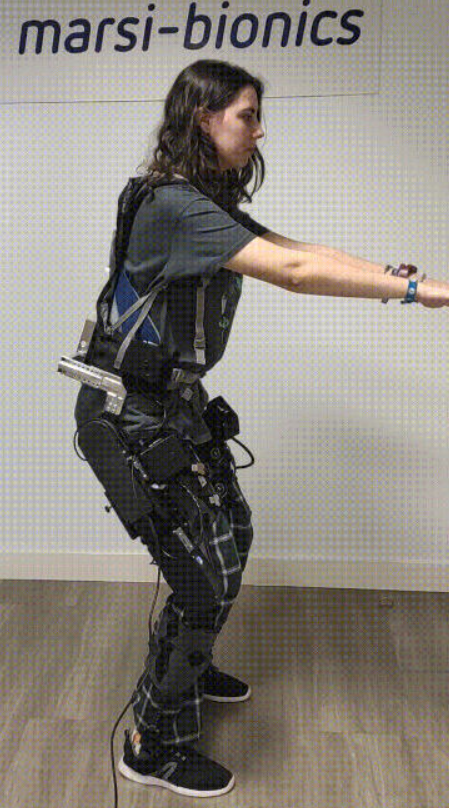
In collaboration with the company Marsi Bionics, a new exercise has been designed rehabilitation for an exoskeleton. After a study of pre-existing information on the device, the necessary content was extracted and a new control system based on the movement of the squats. Thanks to this system,
patients will be able to perform exercises of this type, which is important considering note that it is not a common movement in current devices. Besides, am evaluation has been made with pose neural network models, in order to provide additional assistance in situations where the exoskeleton is not available.

<br />
<br />


Finally, in this project it has been possible to develop a solid and stable solution of the proposed exercise, as well as a comparison of two neural network models verifying that, indeed, although the results are more accurate using the exoskeleton, could be used for support and additional help.

</div>
<p><br />
<br /></p>

<video src="https://raw.githubusercontent.com/RoboticsLabURJC/2022-tfg-veronica-tornero/main/final/video.mp4" controls="controls" style="max-width: 600px;">
</video>]]></content><author><name></name></author><category term="TFG" /><category term="tfg" /><category term="IA" /><category term="exoskeleton" /><category term="tutor:rocapal" /><summary type="html"><![CDATA[Verónica Tornero has successfully presented her final degree project named “Sistema de control para la rehabilitación motora con un exoesqueleto y evaluación de redes posnet como ayuda a terapias”.]]></summary></entry></feed>